
How to Adjust UPVC Door Hinges
How to Adjust UPVC Door Hinges

UPVC doors are incredibly common since they are affordable, durable and generally low maintenance. They are also great for energy efficiency and home security. However, you’ll need to keep your UPVC properly aligned to prevent draughts, ensure smooth operation and maintain security.
If you’ve had your UPVC door for a while, it’ll likely need some adjustments over time due to natural settling of the building as well as frequent use of the door. Hinges can become loose, which would cause your UPVC door to drop out of its frame and make it less effective.
In this article, we advise on how to identify a misalignment, as well as how to adjust UPVC door hinges, with consideration of the different types of hinges. With our guide, you can keep your UPVC door functioning better and for longer.
Shop Door Related Categories
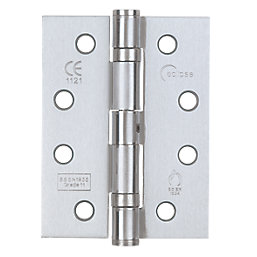


Types of UPVC door hinges
There are three common types of UPVC door hinges: butt hinge, flag hinge and T-hinge. You’ll need to identify which one your door has so you can perform a UPVC hinge adjustment.
Butt hinge
This type of hinge is traditional and can be found on lighter UPVC doors. Butt hinges have two metal plates, known as ‘leaves’, with one attached to the door and the other to the door frame. There is then a pin that connects the two plates so the hinge can pivot. Butt hinges are low maintenance but less flexible compared to other hinge types, as the door is more securely attached to the frame.
Flag hinge
Flag hinges are usually found on more modern UPVC doors, especially those used externally. Named after the shape of a flag, this type of hinge has one metal plate, attached to the door, and a pin that connects it to the frame. It’s much easier to adjust UPVC doors with a flag hinge, as there is more flexibility. You can adjust this hinge laterally and vertically, as well as remove the door from the frame with ease.
T-hinge
T-hinges are similar to flag hinges, but with a T-shape. There is a longer, horizontal metal plate attached to the door and a shorter vertical plate attached to the frame. Like flag hinges, T-hinges on UPVC doors can be adjusted both laterally and vertically, although they offer somewhat less flexibility as you’ll need to reposition the hinge itself. T-hinges are particularly suitable for heavier doors.
Identifying misalignment in UPVC doors
If you suspect your UPVC door is misaligned, there are some simple steps you can take to check if this is the case. First, open the door and physically assess the gap between the door and the frame to see if it is consistent all the way around. Usually, if it is misaligned, there might be a gap at either the top or bottom, or your door might catch on the frame as you open and close it.
On the other hand, if there’s a gap in the middle, your UPVC door may be warped. This can happen with cheaper UPVC doors, and in that situation, you’ll need to replace the door entirely.
Another way to identify a misalignment in UPVC doors is to use a spirit level to check if the door is straight. By placing a spirit level on the top of the door, or along its side, you can see whether the bubble is level. You can also inspect if the mitres, where the door and frame connect in the corners, are uneven. If there are gaps at any point, your door may be misaligned.
Adjusting dropped UPVC doors
If your UPVC door has dropped and drags on the floor, you’ll need to perform a UPVC hinge adjustment. We’ve provided a step-by-step guide on how to do this below:
Step 1. Identify the height adjustment screw.
Depending on the type of hinge, there may be a height adjustment screw you can use to realign your door. This is usually the case for flag hinges, although not with butt hinges and T-hinges.
Step 2. Use a Hex key to adjust the height.
Once you’ve found the screw, you can use a Hex key to adjust the height. Simply turn the Hex key in the screw in a clockwise rotation. You may only need to do 1-2 full rotations to start.
Step 3. Test the door for smooth operation.
While you adjust your UPVC door hinges, stop to check the height of the door and then adjust accordingly. You can then fine-tune until you can open and close your UPVC door without it dragging on the floor.
Adjusting flag hinges
If you’re adjusting flag hinges, you can follow these steps:
Step 1. Access the screws
On a flag hinge, there will be adjustment screws to correct the position of your UPVC door. In some designs, you may need to remove a small plastic cap with a flathead screwdriver to access the screws.
Step 2. Lateral adjustment for flag hinges
To make a lateral adjustment on a flag hinge, you can use a Hex key or Philips screwdriver on the screws at the side. If you need to move the door closer to the hinge, turn the screwdriver clockwise. If it needs moving away, turn it anticlockwise.
Step 3. Vertical adjustment for flag hinges
For a vertical adjustment on a flag hinge, you can find the screw at the top of the hinge. If you need to raise your door’s height, turn it clockwise, and if you need to lower it, turn it anticlockwise.
Step 4. Compression adjustment for flag hinges
You can also make compression adjustments on most flag hinges, which will fit your door into its frame. For a flag hinge, the screw at the bottom usually allows you to adjust the compression, turning clockwise to tighten it or anticlockwise to loosen it.
Adjusting butt hinges
We also discuss how to adjust butt hinges:
Step 1. Lateral adjustment for butt hinges
For a butt hinge, you may be able to adjust it laterally by removing the plastic cap to find the screw on the side of the hinge. Depending on which way you need to adjust, you can use a Phillips screwdriver to loosen either the top or bottom screw.
Step 2. Vertical adjustment for butt hinges
To make a vertical adjustment for a butt hinge, you’ll need to remove the cap on the top of the hinge to find the screw. Then, you can use a Hex key to loosen the screw and adjust the height of your UPVC door.
Step 3. Test and check
You should make small adjustments and keep testing your door to check if it’s in the right position. Follow the steps to identify if there is a misalignment, and keep tweaking until your door is level.
Adjusting T-hinges
If you’re working with T-hinges, here’s how you can adjust them:
Step 1. Loosen T-hinges
You can adjust a UPVC door with a T-hinge by finding the adjustment screw, which is usually at the top or bottom. You can then use a Phillips screwdriver anticlockwise to loosen the screw.
Step 2. Adjust position of T-hinge
Adjust the position of the T-hinge to where it needs to be. If your UPVC door has dropped, you can lift the door up, or adjust it laterally.
Step 3. Tighten T-hinges
Once your door is in the correct position, you can re-tighten the adjustment screw by turning it clockwise with a Phillips screwdriver.
Step 4. Test and check
Again, test the door to see if it has aligned by opening and closing it and using a level to check the gaps are consistent all around. Then, you can make further adjustments if you need to.
How To adjust UPVC door hinges to stop draughts
A UPVC door will only be efficient at preventing draughts if it’s in the correct position. Here are some ways you can adjust UPVC door hinges to stop draughts.
Step 1. Adjust the door latch and strike plate
By adjusting the door latch and strike plate, you can help ensure a proper seal of your UPVC door. Check to see if your door latch and strike plate are aligned.
Step 2. Adjust compression to the door frame
You can also adjust the compression to help your UPVC door fit better into its frame. As we’ve mentioned above, find the compression adjustment screw on your door hinge. You can then use a Hex key to tighten or loosen the gap between your door and its frame.
Step 3. Check weatherstripping
Check to see if there’s a draught by running your hand along the edges of your UPVC door and assessing whether the seals are damaged. If you can feel air, the weatherstripping may be worn-out and you may want to consider using draught excluders.
Key considerations for adjusting UPVC door hinges
If properly installed, UPVC doors can last a long time. They increase energy efficiency and security in your home, while being strong and stylish. However, with continual use, it’s possible for the hinges to become loose or misaligned, in which case you’ll need to adjust the UPVC door hinges.
It’s also important to choose high-quality UPVC doors for durability, as cheaper options can warp over time. If the alignment is unsuccessful then you may wish to consider a new upvc door; check out our collection of UPVC doors, with different styles to suit your home.